What Is FPVS?
Overview
Fast Periodic Visual Stimulation (FPVS) is a powerful method that can elicit strong neural responses to stimuli in just a few minutes of recording time. This method is non-invasive, requires no active participation from the participant, and has been used to study a wide range cognitive processes in the brain from facial expression processing, memory, anxiety, semantic categorization, and more using electroencephalography (EEG).
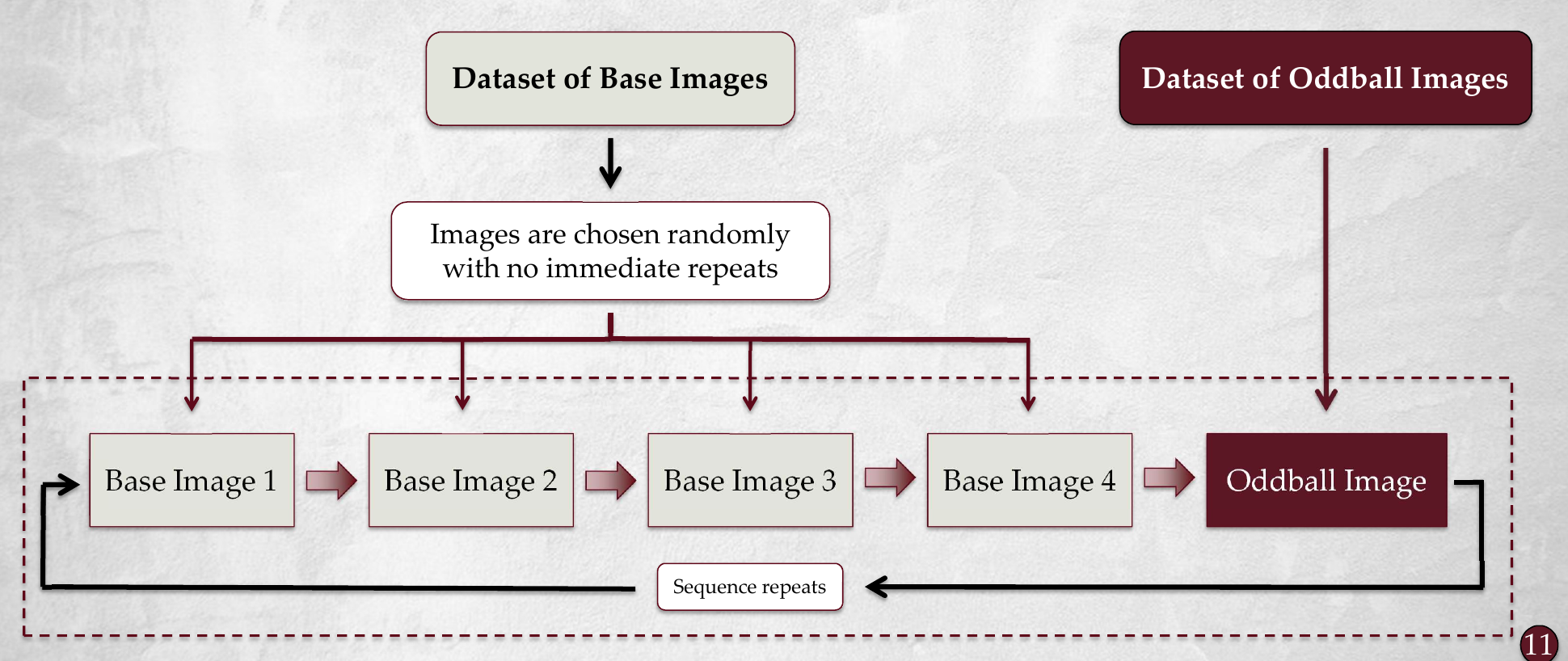
In a typical FPVS experiment, stimuli (usually images or, in some studies, words) are presented on screen to a participant at a fast rate (e.g., 6 Hz, or six times per second). Many recent FPVS experiments follow an ‘oddball’ design, in which a base stimulus is presented at a fixed rate (e.g., 6 times per second), and a different stimlulus type is presented at a less frequent rate (e.g., once every five stimuli, or 1.2 Hz). If the brain detects a difference between the base and oddball stimuli, a neural response will be detectable exactly at the oddball frequency (1.2 Hz in this example) and its frequency harmonics (2.4 Hz, 3.6 Hz, etc). This response can then be measured using EEG. See the figures below for an example of an FPVS oddball sequence.
FPVS Demo
Here is an example of an FPVS condition designed to measure the brain’s response to color changes.
- Base rate
- 6 Hz
- Oddball rate
- 1.2 Hz
- Duration
- 30 s
WARNING: If you are sensitive to flashing images, lights, or have a history of seizures induced by FPVS, please DO NOT watch this demonstration.

Ready when you are.
30.0 s
Preparing the demonstration.
In this example of an FPVS oddball experiment, each image is visible for 83 ms and followed by 83 ms of blank screen.
Why use FPVS?
FPVS combined with EEG offers several important advantages over current EEG techniques. First, when compared with traditional EEG methodology such as event-related potentials (ERPs), FPVS can elicit strong neural responses in a fraction of the time. Second, unlike ERP based methods, FPVS can be sensitive on the level of the individual, which provides future opportunity for use in a clinical setting to aid in the detection and diagnosis of various cognitive conditions. Emerging evidence also suggests that FPVS may index a separate, later stage of cognitive processing than traditional ERPs. Finally, when compared with other neuroimaging methods such as fMRI or PET scans, FPVS + EEG is comparatively inexpensive, portable, and can be used in a wider range of populations and locations.
Important Note
This guide will cover key FPVS concepts and terminology that are important to understanding the advantages and limitations of FPVS, but the guide was built primarily for undergraduate students. As such, certain concepts may be simplified for the sake of explanation. For more detailed and highly technical explanations of FPVS, please refer to the suggested readings or read through the publications linked throughout the guide.