Identify Bad Channels
Find measurements we cannot trust
A bad EEG channel is a recording that is unreliable enough to need exclusion or repair. It might be nearly flat, persistently noisy, or affected by abrupt jumps from a poor connection. Think of it as a suspicious row in our channel-by-time matrix. EEGLAB’s channel-inspection guide shows examples of flat and noisy channels.
This check deserves attention because later steps combine information across channels. If a very noisy channel contributes to an average reference, some of its noise can enter every other channel. Bigdely-Shamlo and colleagues’ PREP paper (2015) explains why identifying unreliable channels and choosing a reference are closely connected.
Look across the whole recording
Scroll through the voltage traces rather than judging a single screen. Compare each EEG channel with nearby scalp channels, using the same voltage scale, and inspect its frequency spectrum for unusual noise. EEGLAB demonstrates both trace and spectrum inspection. Our electrode montage tells us which channels are actually neighbours.
Start looking during acquisition and in the imported raw data, then revisit the result after filtering. A processed trace can hide problems that were visible earlier; MNE recommends checking and marking bad channels early. This workflow’s dedicated step is a place to review those decisions before interpolation and referencing.
A large response alone is not evidence of a bad channel. FPVS responses can differ across scalp regions; the Regions of Interest guide explains why that pattern can be meaningful. Eye channels and trigger channels also have different purposes, so compare EEG with EEG rather than treating every matrix row as the same kind of measurement.
A bad channel or a bad moment?
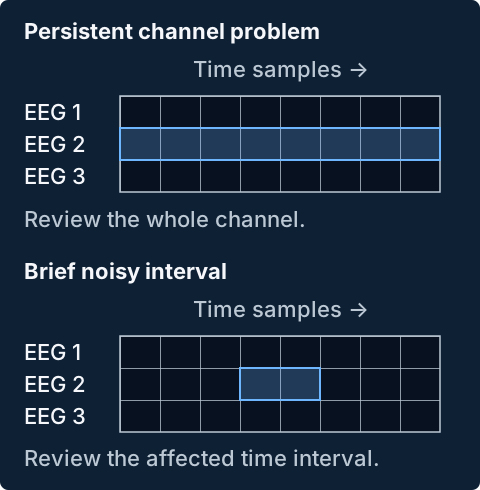
A channel that fails throughout a recording is different from one that briefly becomes noisy. In matrix terms, the first affects a whole row; the second affects only a stretch of time columns. For a brief problem, annotating or excluding the affected interval may preserve more useful data than rejecting the entire channel. EEGLAB discusses this choice.
Automatic checks can flag unusually large variation, excessive high-frequency noise or poor agreement with other channels. The PREP methods give examples. Treat flags as candidates for review using consistent, documented criteria; a threshold from another dataset is not automatically appropriate for yours.
Mark the decision and keep a record
Record the channel name, reason and whether the problem is persistent or limited to a time interval. Keep the original data and verify that later steps use your bad-channel decisions. In MNE, bad-channel flags can be saved without deleting the recorded row. Other workflows remove channels, so keep labels and montage positions aligned with the remaining rows. Replacing a bad row with zeros would create an artificial flat signal rather than repair it.
The next step, interpolation, can estimate a bad channel from good channels and their scalp locations. That estimate does not recover the original measurement. Keep a separate record of which channels were repaired, since interpolation may clear the software’s bad-channel flags.